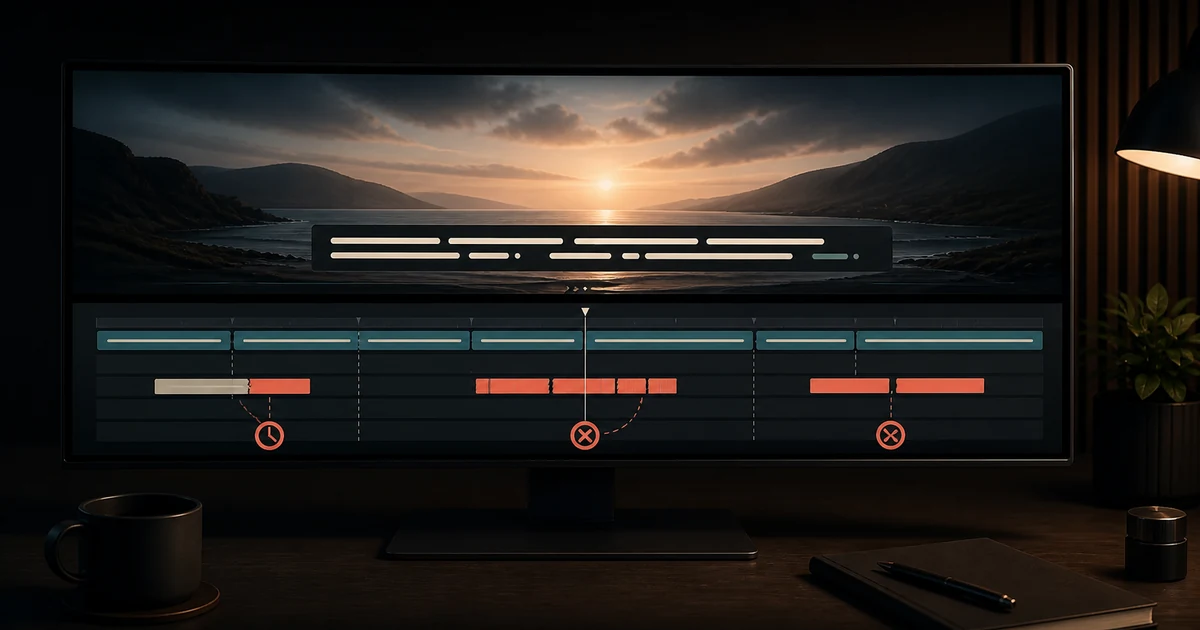
Pause a video on a fluent subtitle, and the sentence may look perfectly good. The meaning is there. The grammar is natural. Nothing seems obviously wrong.
Press play, though, and a different problem appears. The line arrives late, remains on screen for too little time, breaks in the middle of a phrase, or asks viewers to read so much that they miss the action behind it.
That is the central complication in AI subtitle translation: a translation can be semantically adequate as plain text and still be a poor subtitle. In this article, “correct” means that the translated wording preserves the source meaning reasonably well. It does not mean that the finished timed-text file is flawless.
A usable subtitle has to work as language, as timing, and as part of a moving image. Translation quality matters, but it is only one layer.
A subtitle is not just a translated sentence
Ordinary prose waits for the reader. A subtitle does not. It appears at a particular moment, occupies limited screen space, and disappears while sound and images continue.
That changes the quality question. A reviewer cannot ask only whether the target sentence means the same thing as the source. The reviewer also has to ask:
- Does the cue appear and disappear at the right time?
- Can viewers read it without abandoning the image?
- Are the words divided into sensible lines and subtitle blocks?
- Is the wording concise enough for the available time?
- Does its position avoid covering important visual information?
Research on subtitle evaluation makes this distinction explicit. SubER, a metric developed for automatic subtitling, evaluates text together with segmentation and timing. In its bounded study, that combined approach matched professional post-editing effort and human assessment better than text-only baselines. The study does not establish one universal measure of subtitle quality. It does show why evaluating translated words alone leaves important work invisible.
Two AI subtitle translation workflows are easy to confuse
“AI subtitles” can describe at least two different workflows.
In the first, a system receives an existing subtitle file—often an SRT file—with text divided into cues and paired with timecodes. The system translates the text while retaining that template.
In the second, an automatic-subtitling system may have to recognize speech, decide where subtitle blocks begin and end, translate them, assign timing, create line breaks, and sometimes shorten the result.
The distinction matters because preserving the source timecodes is not the same as proving that the target-language text fits them. Languages differ in word length, grammar, information density, and natural phrasing. A translated cue may expand even when its timestamp remains unchanged. The file can therefore be technically synchronized to the old schedule but uncomfortable in the new language.
Modern systems are not necessarily blind to this problem. Work presented at IWSLT 2024 and IWSLT 2025 explicitly models subtitle boundaries, line and block limits, reading-speed conformity, timing, and controlled compression. That is an important counterweight to the easy claim that “AI only translates the words.” Some systems are designed to handle more.
The practical issue is narrower: fluent translated text is not evidence that every other subtitle layer was handled well. An AI subtitle translation workflow still has to show that the translated cues fit the target language, the timecodes, and the screen.
The clock changes what good wording looks like
Suppose a speaker delivers a dense sentence in a few seconds. A complete translation may preserve every detail, yet force the viewer to choose between reading the subtitle and watching the scene. That pressure exists whether a system translates an existing SRT file or produces the subtitle file from speech.
This does not mean that one reading-speed number separates good subtitles from bad ones. Platform specifications vary, languages behave differently, and viewers differ. In a PLOS ONE eye-tracking study, many participants coped with subtitles at 20 characters per second, and comprehension did not fall across the tested speeds. Viewers also cared strongly about synchronization and correspondence with the dialogue.
The lesson is not “fast subtitles always fail.” It is that speed has to be evaluated in context. Dialogue density, shot content, language, audience, and delivery requirements all matter.
Production guides make those requirements concrete. Netflix, for example, publishes separate timed-text style guides and subtitle timing guidelines covering reading speed, duration, synchronization, line treatment, and positioning. Those values are Netflix delivery specifications, not universal scientific laws. Their separation still illustrates the larger point: text accuracy does not settle timing quality.
The same words can become harder at the wrong break
Line breaks and cue boundaries are not decoration. They organize how the viewer meets the sentence.
Compare these two hypothetical breaks:
The committee approved the proposal
after the final safety review.
and:
The committee approved
the proposal after the final safety review.
Both preserve the same words. Depending on the scene, timing, and available space, however, one division may align more naturally with the sentence structure.
Experimental findings support a cautious version of this effect. A study of subtitle segmentation found that non-syntactic segmentation could increase reported difficulty, effort, and frustration, although it did not reduce comprehension in that experiment. A separate eye-tracking and preference study on line breaks found that viewers generally preferred syntactically segmented alternatives, with effects varying by unit and viewer profile.
So an awkward break does not automatically make a subtitle incomprehensible. It can still make the viewing experience less natural and more effortful—an important failure even when every translated word is defensible.
Sometimes a literal translation preserves the wrong thing
When target-language text expands, the apparent solution is to keep the full translation and display it faster. Another is to condense it. A literal translation may be accurate sentence by sentence and still be too long for the cue it has to occupy.
Condensation can reduce reading load, but it is not a free fix. Removing repetition, recoverable detail, or a redundant phrase may help a cue fit. Removing a qualification, joke, relationship, or plot-relevant detail may damage the translation.
This creates a real tradeoff. The aim is not the shortest possible subtitle. It is a version that preserves the material meaning while fitting the time, space, scene, and audience. The IWSLT systems cited above treat compression as an optimization problem precisely because improving one constraint can put pressure on another.
That is also where linguistic judgment remains valuable. A model can propose shorter alternatives. A competent reviewer can decide what the scene allows to be compressed, what the audience needs, and which detail cannot be sacrificed.
The picture is part of the sentence
Subtitles are read over faces, gestures, signs, interfaces, action, and edits. A line that works over an empty background may cover important information in the next shot. A cue can be accurately translated but poorly placed, mistimed against a reaction, or left on screen after the speaker’s contribution has clearly ended.
Not every cut demands a new cue, and crossing a shot change does not automatically force viewers to reread. The useful principle is contextual: timing and placement should support the scene instead of following a mechanical rule without regard to what viewers need to see.
It is also important not to use “captions” and “subtitles” as if they were always identical. W3C guidance explains that captions normally include same-language speech and relevant non-speech audio, while subtitles normally translate dialogue, although regional terminology varies. A translated dialogue track does not automatically provide the speaker identification, sound information, and other features needed for accessible captions.
What a reliable subtitle review actually checks
A useful human review separates the file into layers and then checks how those layers interact. This is the difference between proofreading an AI translation as prose and reviewing a complete subtitle translation.
Semantic review: Does the target text preserve the source meaning, tone, terminology, relationships, and relevant detail?
Temporal review: Do cues enter and leave in a way that matches the speech and gives the intended audience a realistic chance to read?
Structural review: Are blocks and lines divided at sensible linguistic points, and do timing and formatting fit the delivery requirements?
Visual review: Do the subtitles work with the actual picture, edits, graphics, and viewer attention?
An AI-assisted subtitle workflow can contribute at every stage. It can generate a translation, suggest segmentation, estimate reading speed, preserve or adjust timing, and propose shorter alternatives. It can help translate subtitles efficiently, but each change still has to match the visual context and the intended audience. The final question is not whether AI was involved. It is whether the finished file was evaluated as subtitles rather than admired as fluent text.
For video content that has to work in another language, LumaVerba’s subtitling service combines subtitle translation with the timing, segmentation, and on-screen constraints that the format requires.
Correct on pause, usable in motion
The paused subtitle from the beginning did not become linguistically wrong when playback resumed. Its hidden constraints simply became visible.
That is why AI subtitle translation deserves a more precise standard than “the sentences look good.” Meaning must survive. So must readability, timing, structure, and the viewer’s access to the scene.
AI can help produce all of those elements, and increasingly sophisticated systems attempt to optimize them together. But a fluent translation remains only one piece of evidence. A subtitle succeeds when the right meaning reaches the viewer in the limited time and space the screen allows.
Sources
- Wilken, Georgakopoulou and Matusov (2022), “SubER: A Metric for Automatic Subtitling Quality”
- Papi et al. (2024), “Automatic Subtitling and Subtitle Compression”
- Petrick et al. (2025), AppTek’s IWSLT automatic-subtitling system paper
- Szarkowska and Gerber-Morón (2018), “Viewers can keep up with fast subtitles”
- Gerber-Morón, Szarkowska and Woll (2018), “The impact of text segmentation on subtitle reading”
- Szarkowska et al. (2020), “Line breaks in subtitling”
- W3C WAI, “Captions/Subtitles”
- Netflix Partner Help, Timed Text Style Guides
- Netflix Partner Help, Subtitle Timing Guidelines